

Whack...thud! Those were the sounds my head and backside made as my head rammed into the edge of the open bay door so hard it knocked me off my feet and onto the driveway.
It was a hot, sunny day while Juan was working in our electrical bay. We


Whack...thud! Those were the sounds my head and backside made as my head rammed into the edge of the open bay door so hard it knocked me off my feet and onto the driveway.
It was a hot, sunny day while Juan was working in our electrical bay. We
After wiring the inverter to the 120V load center, we were ready to wire up all of the A/C circuits. We have seen many bus conversions and RVs that only have a couple of A/C circuits. But, we would like to be able to cook something in the
After wiring up the supply side of the system, it was time to actually prepare to send that power somewhere. We decided to start with the 120V A/C side of things. Our starting point was to map out where we need 120V in the bus and how many different
When we bought the bus, we knew that we would need to redo the dash and switch panels. The wood was cracking, was poorly cut, and was generally looking sad. In addition, some of the gauges didn’t work very well, and some didn’t work at all. The old
The time had finally come to install our Nissan Leaf battery into the bus. To be honest, this whole thing has been such an experiment, we were kind of surprised we actually got to this point.
When Juan took out the old factory bus heat and a/c components in
After reconfiguring the Leaf battery modules into a 48V system, we were ready to build a stand for them. It needs to fulfill a few requirements. First, it needs to support the upper portion of our battery bank which weighs in at about 200 pounds (400 pounds for both upper
We knew pretty early on that we were going to need to replace the rooftop a/c for a few reasons. First, it simply didn’t cool the bus down very well. It was a 13,500 BTU Coleman Mach unit. It blew cold, but it just didn’t push
Holey bus, Batman! That’s holey, not holy. During the demo process, we created a lot of new holes in the exterior of the bus. We removed the city water inlet - small hole. We removed the tv cable inlet - small hole. We removed the furnace vent - medium
When we bought the bus, the entryway and stair risers were covered in carpet. The carpet in the bus was old and in bad shape, so pulling it out was one of the first things we did in the demo process. What remained underneath left a lot to be desired,
Our bus has three vent fans in it, but, oh man, the ones that were in there when we bought it were redonkulous. That word bugs me, but I couldn’t come up with a better description. The fans were teeny tiny, PC-style fans.
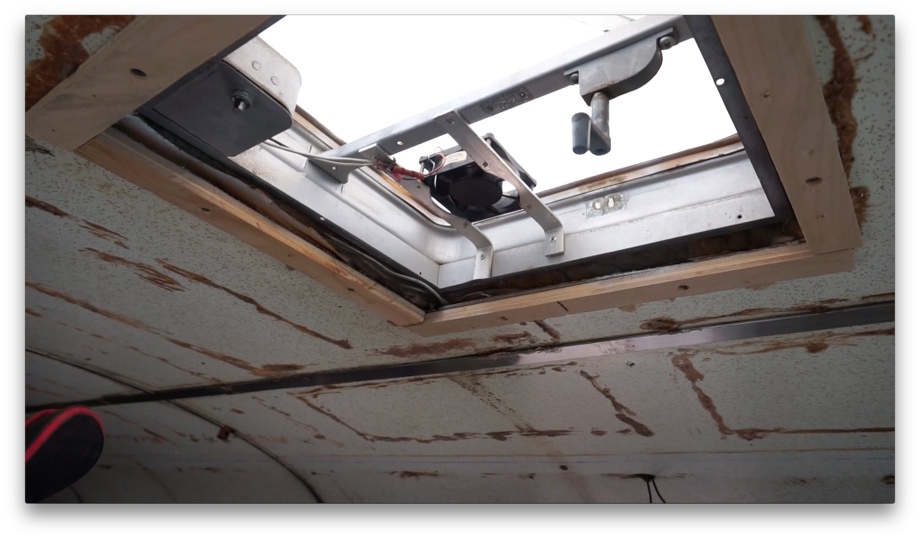 I mean, how in the world
Back in March, it was already getting close to 100 degrees F here in the Phoenix area. We knew we needed to get the bus insulated quickly. We researched several options but decided to go with Roxul AFB. Our friends the Bareneckers had used it on their Airstream renovation, and